

WhatsApp Us

Gearbox and Transmissions Explained

Your gearbox has a busy job…

Every time you pull away, climb a hill, or settle into motorway traffic, it helps turn the engine’s output into useful movement at the wheels. Yet most drivers only give it much thought when something changes: a judder, an unfamiliar whine, or a hesitation when selecting drive.

At CCM, we believe understanding your vehicle should help you feel more confident about looking after it. Here’s how the main transmission types work, what maintenance they may need, and how technicians get to the bottom of a fault.

What is a transmission?

The transmission transfers drive from the engine or electric motor towards the wheels.

In everyday conversation, “transmission” and “gearbox” usually mean the same thing, although transmission can also refer to a broader set of components that deliver that drive.

In a petrol or diesel car, the gearbox changes the relationship between engine speed and road speed.

Low gears multiply the engine’s turning force, known as torque, to help you pull away or climb hills. Higher gears let you travel faster at lower engine revs. Think of bicycle gears: a low gear makes getting moving easier, while a higher gear suits cruising.

A car’s gearbox follows a similar principle, with rather more engineering inside.

What types of gearboxes are there, and how do they work?

Modern drivers have a wide range of transmission types to choose from, each offering a distinct driving experience.

Manual Transmission Gearbox

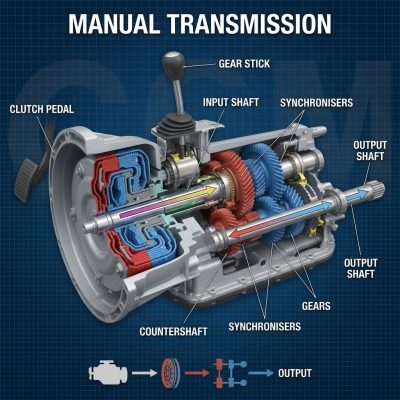
Manual Transmission

The traditional choice in the UK, requiring the driver to operate a clutch pedal and physically move a gear stick to select gears.

They are mechanically simpler, highly durable, and give the driver total control over engine speed.

Semi-Automatic Transmission Gearbox

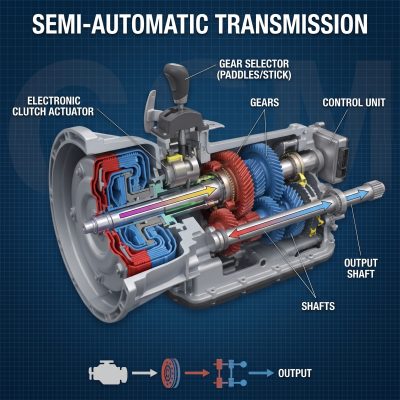
Semi-Automatic Transmission

Sometimes called automated manuals, these use the robust mechanical internals of a traditional manual gearbox, but rely on electronic actuators and computers to operate the clutch and shift the gears for you, often via paddles on the steering wheel.

Standard Automatic Transmission Gearbox

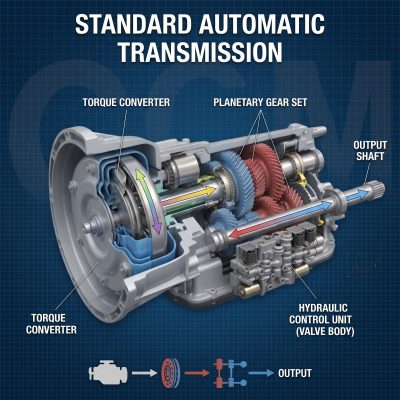
Standard Automatic Transmission

The traditional automatic relies on a torque converter and planetary gears instead of a physical clutch.

By using hydraulic fluid to transfer power, they offer an incredibly smooth driving experience, particularly in heavy stop-start traffic.

Dual-Clutch Automatic Transmission Gearbox

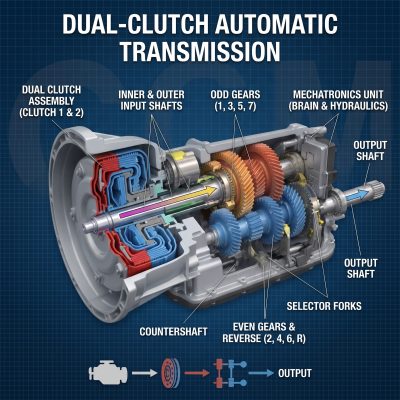
Dual-Clutch Automatic Transmission

These advanced gearboxes essentially house two separate manual transmissions and two clutches inside one casing.

Controlled by a complex computer called a mechatronics unit, they pre-select the next gear for lightning-fast, seamless shifts.

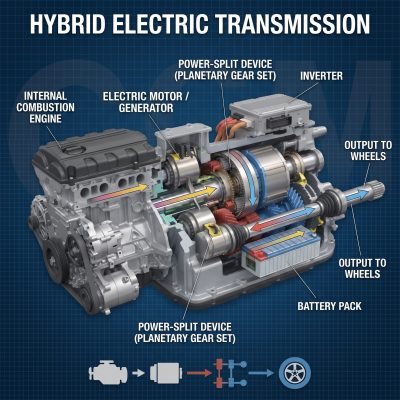
Hybrid Electric Transmission Gearbox

Hybrid Electric Transmission

Designed to blend power from both an internal combustion engine and an electric motor, these complex systems often use specialised planetary gear sets or electronic continuously variable setups to seamlessly transition between power sources and maximise fuel efficiency.

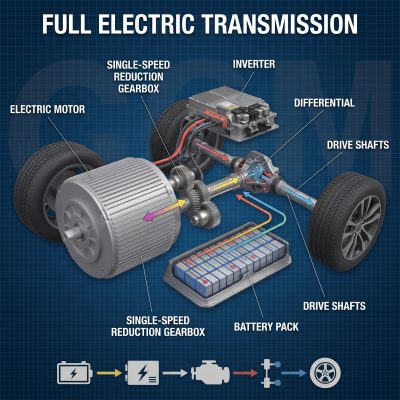
Full Electric Transmission Gearbox

Full Electric Transmission

Because electric motors produce their maximum rotational force (torque) instantly, fully electric vehicles generally do not require multi-speed gearboxes.

Instead, they utilise a highly reliable, single-speed reduction gear to transfer the motor’s power smoothly and directly to the differential and wheels.

What regular maintenance does a gearbox need?

The correct maintenance schedule depends on the exact transmission fitted to your vehicle. There is no single oil-change interval that suits every manual, automatic, DSG, or CVT.

Depending on the design, maintenance may include:

  • Replacing gearbox oil or transmission fluid at the specified interval.
  • Changing a filter or sump assembly where required.
  • Checking for leaks, including around seals, pipes, and the sump.
  • Inspecting related components, such as clutch hydraulics, mountings, and transmission cooling systems.
  • Transmission fluid can do much more than lubricate. In many automatics, it also transfers hydraulic pressure, helps control clutch engagement, and carries heat away.

The fluid specification, filling procedure, and final level all matter. Some gearboxes require the level to be set within a particular temperature range using diagnostic equipment.

What about “sealed for life” or “lifetime” oil? Those descriptions need to be considered alongside the vehicle and transmission manufacturers’ guidance and the car’s use. Heat, towing, and demanding conditions can affect oil life. Ask for advice specific to your gearbox rather than relying on a general mileage rule.

An engine oil service does not necessarily include transmission servicing. It is worth checking the service history to see exactly what has been done.
What happens when something goes wrong?

Gearbox problems can involve mechanical wear, hydraulic pressure, electronic controls, or a combination of these. A leak may reduce lubrication or pressure; worn friction components can slip and generate heat; a sensor or wiring fault can disrupt gear selection.

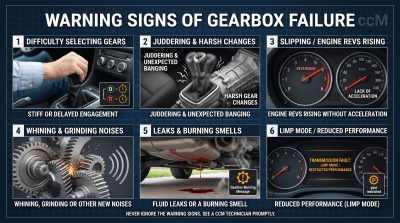
Warning signs include:

  • Difficulty selecting gears, or a delay when engaging drive or reverse.
  • Juddering, harsh changes, or unexpected banging.
  • Engine revs rising without a matching increase in speed.
  • Whining, grinding, or other new noises.
  • Fluid leaks, a burning smell, or a transmission warning message.
  • Reduced performance or being restricted to one gear, sometimes called limp mode.

These symptoms do not prove the gearbox needs replacing. Clutch faults, engine misfires, worn mountings, and driveshaft problems can produce similar complaints.

Report changes promptly. Continuing to drive with slipping, overheating, or low fluid can turn a repairable fault into more extensive damage. If the vehicle loses drive, makes severe grinding noises, or displays an instruction to stop, pull over safely and arrange assistance.

How do technicians identify and fix transmission issues?

A useful diagnosis brings together what the driver has noticed, physical checks and test results.

Understanding when the fault happens

Does it happen from cold, after a long journey, when reversing or under acceleration? Has any recent work been carried out? These details help narrow the investigation.

A road test, where safe, can help reproduce the symptom and establish the conditions that trigger it.

Checking the vehicle and its data

Technicians inspect for leaks, damage and related faults, and check fluid level and condition using the correct procedure. On electronically controlled transmissions, diagnostic equipment reads fault codes and live operating data.

A fault code is a clue, rather than an instruction to replace a particular part. Further checks may involve wiring, sensors, clutch operation, hydraulic pressure or the gearbox’s response to controlled tests.

Choosing the right repair

The findings determine the next step. A repair might involve a seal, clutch operating component, sensor, wiring, control unit, valve body or mechatronic assembly. Internal wear may require dismantling, rebuilding or replacing the transmission.

An oil service may be appropriate in some cases, but fresh fluid cannot repair worn gears or damaged clutch packs. A flush is not a universal cure either: the method should suit the gearbox and its condition.

After repairs, some systems require programming, calibration or a manufacturer-specified relearning procedure. Final checks and a road test help confirm that the original complaint has been resolved.

Gearbox advice from CCM

Whether you drive a manual, an automatic, a hybrid or an EV, understanding what is fitted to your car is the starting point for looking after it.

At CCM, we can help you understand your transmission’s maintenance needs and investigate changes in how your vehicle drives. Our aim is to explain the findings clearly, so you understand the recommended work and why it matters.

Noticed a change in your gear shifts, or unsure whether a gearbox service is due? Contact the CCM team at Ewhurst, Cranleigh or Gatwick to discuss your vehicle.

© CCM - 2026